Former Miss America and singer Suzette Charles burst on to the UK pop scene back in 1993 with a ton of potential, only for a series of events outside her control conspiring to thwart her burgeoning singing career.
But 30 years later, she's back. And she's back with the best pop album of the year!
Back in 1992, Suzette was signed to RCA America, and, unhappy with the material she was being offered by her stateside label, travelled to the UK to work with songwriters & producers Mike Stock & Pete Waterman, the remaining two-thirds of Stock Aitken Waterman (Matt Aitken having departed by this point).
However, RCA America was unhappy that Suzette had arranged this under her own steam without their agreement, which strained their relationship. One of the 6 tracks recorded with Stock & Waterman - Free to Love Again - was however released by RCA UK, just as Stock & Waterman’s own working relationship was imploding.
Free to Love Again missed the Top 40, Stock & Waterman went their separate ways, and Suzette found herself without a label and a production team.
Marriage and family life took Suzette away from her musical ambitions, but she always thought about the unfinished business of her music career.
Which brings us to the present day, with Suzette’s debut album finally released at the end of May 2026.
With Mike Stock again at the helm, this collection of faithfully re-recorded versions of the original 6 tracks and 5 brand new tracks shows that some things are really worth the wait.
Towards the end of the Stock & Waterman years, they had gone back to their soul roots, echoing their earlier work with the likes of Princess & the Three Degrees - and that modernised soul/garage/new jack swing take was the style they went with for those initial tracks with Suzette. The new recordings of these 6 original tracks are faithful enough for the fans who have heard the leaked versions over the years, but are modernised enough for 2026 ears. Pleasingly, the new tracks fit in seamlessly, melodically and arrangement-wise, showing that Mike Stock still knows his way around a good song. Also worth mentioning that mixing duties are provided by former PWL Mixmasters Pete Hammond and Dave Ford, both of whom contribute to the sheen of this album.
Free to Love Again opens the album, and the faithful pop-house arrangement only serves to remind me that this should have been a hit back in the day. Whenever You’re Around is soulful, grown up and taps into the Japanese City Pop genre; this one took me a couple of listens, but once it gets in your head, it doesn't let go. The ultra-catchy Don’t Stop (All The Love You Can Give) leans more towards pop than soul, but some funky house piano keeps the balance. See Your Smile has a Philly sound to it, and a great call and answer verse between Suzette & the backing vocalists. Nothing to Hide is probably the tour de force track on the album, with its straight down the line pop chorus, with chunky beats and great guitar work. We Lost The Beat is the most impressive track; a mix of Chic, Donna Summer and Mel & Kim, it’s a bit off the wall but a terrific blast of disco. What the Eye Don’t See is a real 90’s dance throwback, with an incessant bassline and punctuated by a bit of Hammond organ. After You’re Gone is a midtempo track with a spiritual lyric & great harmonies. Just For A Minute is a slab of classy soul-pop, with a killer chorus. Simple Life is a perky upbeat track with a hypnotic chorus. And wrapping the album up is killer ballad Every Time We Touch, which Suzette really delivers on.
As a long time Stock Aitken Waterman fan, this is the album I always wanted but never thought I’d get. For me, it’s an absolute belter of an album. Mike Stock, along with his son James and their team, has genuinely delivered a high quality pop album that is looping in my head even when I am not listening to it (and I am currently listening to it a lot). For me, Nothing to Hide is the standout track, followed closely by We Lost The Beat, but See Your Smile is the dark horse of the album I think; its chorus is already etched into my brain.
So, if you’re a SAW fan, you should definitely check this out. And if you aren’t, it’s still worth checking out as you may be pleasantly surprised. You can find it on streaming, download, as well as vinyl and CD (with an additional deluxe edition on the latter format, also carrying 6 remixes by former PWL Mixmaster Pete Hammond).
A few oddities I've picked up from trawling old copies of Music Week and Record Mirror:
Did Stock Aitken Waterman / PWL produce an act called Body Band around 1987, which featured ex-Toto Coelo member Lacey Bond?
Did Stock Aitken Waterman / PWL work with a CBS act called Steve & Jessie, a pair of identical twins from America, also around 1987?
And it appears that Stock Aitken Waterman were going to work on a set of jingles for the UK London commercial Capital Radio Radio station around 1987/1988: apparently they were too busy to complete them!
Yes, I know it’s been a long time… but I simply had to bring this blog out of hiatus to write a bit about Gavin Scott and Matthew Denby’s wonderful podcast A Journey Through SAW.
It is quite simply the documentary series all SAW fans have coveted for many years, and quite frankly, I struggle to think about who could have done a better job than Gavin & Matthew.
If you’re reading this blog, then you will of course know about the podcast, so there’s no need for me to go into detail about it. Nor do I want to spoil the experience for new listeners by going through all of the juicy info that Gavin & Matthew have uncovered. But should you not be aware of it, the podcast is telling the story of SAW using each of their released UK singles as touchpoints, from first SAW single The Upstroke through (I expect) to Slamm’s Virginia Plain, though I believe they will cover post-SAW product in some form, and will no doubt cover the latterday Stock & Waterman one-offs as well as the full SAW reunion for the remix of Kylie’s Every Day Is Like Christmas.
The podcast is a seriously impressive endeavour; Gavin & Matthew are journalists, and it’s clear how much those skills and that background contribute to the whole affair. They have tracked down all manner of contributors – many of whom we have not heard from before – and have gotten some great stories and viewpoints from. They know their stuff and their quality standards around information are high. And crucially, they are not afraid to voice their opinions if they do not like certain tracks, but remain respectful when doing so.
I especially like how Gavin positions himself as good cop, with Matthew being bad cop (in a good way, if that makes sense); it’s fun when the two do not agree on something.
Whilst Gavin & Matthew are following in the footsteps of the great fan researchers such as Jeremy Kay, Paul Smith, John Palmer, Dave Roberts & Tom Parker, they are actually taking the whole SAW fandom wider as their podcast gains increasing recognition. And deservedly so.
Anyway, I wanted to share 10 things I have learned from A Journey through SAW, so here goes:
1)Suzanne Rhatigan would be my ideal dinner party guest
Like many diehard SAW fans, you kind of get used to hearing the same old stories from the same old people – which is absolutely fine, but one of the joys of this podcast is hearing from people who haven’t told their story before. I loved hearing from people like Yoyo, Dee Lewis and Nick East, but Suzanne Rhatigan was an absolute delight. She was enthusiastic, friendly, honest yet respectful and hilarious. I could listen to her reading the full SAW discography. In particular, I loved her story about getting in trouble with Pete Waterman because Suzanne’s mum had unwittingly leaked a story to the Irish press! If this was my podcast, Suzanne would be on every episode.
2)Matt Aitken is refreshingly honest about the SAW back catalogue
Well I guess I kind of knew this anyway from what others have said about Matt Aitken, but what I really like about Matt’s contribution to the podcast is that he will give his view on whether a track worked or not. This is different from Mike Stock, who I feel is more defensive of SAW’s work (which is fair and proper – and I’ve spent 30-odd years defending their work too). By the way, it’s great that Matt has started to contribute more to retrospective projects such as the podcast; I feel his account of events is helping to give a fuller view of SAW’s history.
3)Sheila Ferguson’s version of Always Doesn’t Mean Forever has different phrasing in the chorus than Hazell Dean’s version
Always Doesn’t Mean Forever is genuinely one of my favourite SAW tracks, and it was a real thrill to hear a snippet of the original & unreleased Sheila Ferguson version. I love the sneaky way Gavin introduced it as the Hazell Dean version, and then stopping it after 20 seconds to correct himself! At first, I thought “ooh I haven’t heard this mix before”, before realising what version it actually was! The biggest surprise was that the phrasing of the “Always doesn’t mean forever” is different, in the way that the phrasing of the “Got to be certain” line is different in Mandy Smith’s version of Got To Be Certain to Kylie Minogue’s. Great to hear the snippet, and hopefully one day we will get to hear the full Sheila version (and the rest of her unreleased tracks).
4)Romi & Jazz could – and should – have been the next Mel & Kim
Gavin & Matthew did a great episode recently with a big focus on Romi & Jazz, whose sole 1990 SAW track One Love One World is a favourite of mine. The boys did a great overview of Romi & Jazz’s career leading up to the SAW collaboration, and it was great to hear Romi & Jazz now looking back on that time with fondness. Matt Aitken made a comment – “(We’ve) hit the jackpot here – where did it all go wrong?” – which got me thinking about the parallels between Romi & Jazz and Mel & Kim. One Love One World probably isn’t as revolutionary a track as Showing Out (Get Fresh at the Weekend) was, but it was a case of SAW applying emerging club sounds to a pop track and doing something new (like using a spoken sample as the bridge). I think if Chrysalis had managed to break this single, then Romi & Jazz had a great chance of forging a successful career, especially if they had stayed with SAW and also if they had the opportunity to bring in the Bhangara elements more.
5)The story around how Princess parted ways with SAW and Supreme Records was even more fascinating than I thought
This was an early coup for Gavin & Matthew, and one which really showed that their podcast is a very special endeavour. They got Princess to agree to a comprehensive interview when the podcast had only started and was still building its profile, which is a great feat, but Gavin’s interviewing skills clearly put Princess at ease as she was able to be very candid about her experience. I want people to listen to the podcast so I am not going to go through the details here, except to say it’s clear there were lots of personalities at play and it seems Princess herself may have been caught in the crossfire. When your record label puts out a single with a text only cover, you know there’s a problem. I was also fascinated by Gavin & Matthew’s observation that one of the problems affecting Princess’s success was a move away from the pure soul of Say I’m Your Number One, as subsequent releases became more poppy (although final SAW single In the Heat Of A Passionate Moment went in a totally different direction and embraced Chicago House).
6)Lisa Fabien’s story of missed opportunities with SAW was a heartbreaking indictment on the record industry
If you’re a fully-signed up member of SAW fandom, then you will know the name Lisa Fabien but will not know much about her. Gavin & Matthew changed all that when they tracked her down. Lisa was a vocalist who was in the SAW and PWL orbit; she duetted with Rick Astley on the pre-Never Gonna Give You Up single When You Gonna (produced by Harding & Curnow), and later was the credited vocalist on the unreleased 4th SAW single Better Than Ever. It turns out that Lisa was signed for a deal and was given assurances that she was going to be the next big thing… before being unceremoniously dropped before anything actually happened. Sure, the history of pop music is littered with stories about artists who almost but never made it but Lisa’s experience, as she tells it, sounds really unfair and hurtful.
7)Kylie wasn’t actually flying back to Australia the day I Should Be So Lucky was recorded
Go and listen to Terry Blamey on the recent Better The Devil You Know part 1 edition of the podcast but it seems that Terry Blamey told a white lie about it being Kylie’s last day in the UK in order to force SAW to record Kylie. It’s bonkers he had to do that, but thank god he did. And this revelation only adds to the labyrinthine legend of how I Should be So Lucky was born.
8)Jamie Morgan’s life should be made into a film
I am slightly obsessed by Looking Good Diving by Morgan McVey, so it was great to hear from Jamie Morgan about how that track came together. What was even better for me was Jamie’s story about being chased by a murderous boyfriend who wrongly thought Jamie had copped off with his girlfriend, and how Jamie escaped into a club to hear DJ Tim Simenon playing B-side Looking Good Diving With The Wild Bunch, which led to Simenon producing Neneh Cherry's Buffalo Stance. Absolutely fascinating and brilliantly hilarious.
9)The guitar solo on Samantha Fox’s Nothing’s Gonna Stop Me Now was played on keyboard
Matt Aitken is of course an amazing guitarist, but I was already aware (having been lucky enough to have a brief email correspondence with Matt in the early 2000s) that a number of his guitar solos were actually performed on keyboard and routed through the Rockman guitar amp. Once I knew that, I was able to hear the difference between the keyboard solos (even though they were impressively done) and the real guitar solos. However, I was absolutely certain that the solo on Nothing’s Gonna Stop Me Now was the real deal – until Gavin revealed to Samantha Fox on the podcast that that particular solo was a keyboard/Rockman special. This is what’s great about the podcast; it’s easy to think that you know it all after nearly 40 years of being a fan, and then Gavin & Matt pull something out of the bag!
10)The mystery of the Roland Rat & SAW collaboration may have been solved
If you’re a die-hard SAW fan, you will know that they produced and co-wrote a number of tracks for UK TV puppet Roland Rat, one of which was the theme to the 1986 BBC TV show Roland Rat – The Series; these tracks ended up on an album, with the theme song released as a single. However, in Mark Elliott’s excellent 2017 book The Ministry of Pop, Mike Stock said he had no recollection of working on these tracks at all. Now, we know there have been occasions when a record contained a SAW credit but was actually the work of Pete Hammond or Phil Harding (and sometimes had nothing to do with SAW or PWL), but these tracks – at least in production terms – sound like SAW to me. Especially when you consider the Roland Rat-free version, which is a great slab of Chicago House and actually a proto-version of the Mel & Kim sound. But on the podcast, Mike re-iterated that he does not recall any involvement in these tracks, and I have no reason to doubt his account (he was there, after all – or, in this case, wasn’t!). He does suggest Matt Aitken was involved in putting the backing track together. Not only that, Phil Harding – credited as mixer – also cast doubts on his own involvement. The last word – for now – comes from the always-excellent John Palmer, who has suggested (and I am paraphrasing here) that perhaps SAW provided backing tracks to the BBC, probably for toplines to be written over them by composer Simon Brint, scriptwriter Lise Meyer & David Claridge, the man behind Roland Rat. This could explain the full-on Chicago House Roland-Rat-free version of the track with a female-sung verse (and no chorus); was this the original version of Living Legend rather than a remix of it as many of us have thought?
A quick note for the subscriber-only bonus material, which is already a treasure trove of expanded & additional interview material, as well as some special episodes where Gavin & Matt focus on a particular topic, album or artist. At roughly £2 per month, this is a steal.
In closing, the podcast is not only a history of SAW, but it’s also a wider cultural history of the music industry in the 1980s and 1990s – a double achievement then! A big well done and thank you to Gavin & Matt!
Over the years, Stock Aitken Waterman tracks have come in
for a lot of criticism (largely unjustified), but some tracks even get a bad
reputation amongst SAW fans. One such track is Jason Donovan’s 1990 single Hang
On To Your Love, but why is this the case...?
1989 had been an amazing year for Jason Donovan, and he
entered 1990 on the back of the success of the well-received When You Come Back
To Me. There was a sense that Donovan was in a strong position to consolidate
that success, as indeed were his producers Stock Aitken Waterman. However,
Donovan’s first single release of 1990 would come to be regarded as something
of a misstep.
Hang On To Your Love was, as usual, a Stock Aitken Waterman
composition and production, recorded in January 1990 as part of the initial sessions
for Donovan’s second album, Between the Lines. It would seem that, consciously
or not, that SAW was starting to move Donovan’s sound away from the bright pop
that characterised his previous material.
One of the hallmarks of Stock Aitken Waterman tracks, especially
self-composed, was the dichotomy between upbeat production and downbeat lyrical
content. And that had been the case with many of the tracks on Donovan’s debut
album Ten Good Reasons, such as Time Heals, Too Late to Say Goodbye and If I
Don’t Have You. But Hang On To Your Love brought a darker edge to proceedings.
Sure, the beats and percussion are still present, but the
synths are heavier, the strings more dramatic and the electric guitar adds to
the bleakness. This is all topped off by Donovan’s doleful delivery: “Just to
think I had the world in my hands / And I let it slip through my fingers”
opines Jason, “I guess I didn’t know what I had / It’s just a memory that
lingers”.
The result is that, at the time and even now, there was a
pervading view that Hang On To Your Love just wasn’t as good as Donovan’s
previous singles, to the point where even fans found it unlikable.
So this is where I come in. Because I think Hang On To Your
Love is great.
I actually prefer it to When You Come Back To Me. I love its
drama. I love its boldness. I love the spirit of Abba that the melody has. I
love the thicker, chunkier arrangement. And I love the guitars.
So why is it so disliked?
Listening to it again for this article, the most striking
thing about it is just how downbeat it sounds. The light and twinkly Yamaha Staccato
Heaven preset was all over Ten Good Reasons, but here we have a thumping
bassline and pounding beat accompanied by doleful synths.
And this brings me to my main proposition. Hang On To Your
Love moves away from the aforementioned contrast between upbeat arrangement and
melancholic lyrics/themes, and instead provides a double whammy of melancholic
arrangement and lyrics. As a result, the usual bittersweet combination of joy
and sadness is sacrificed for melodrama.
And it is quite a dramatic record, at least in terms of
arrangement and production. The opening combination of electric guitar and
strings is impressive, but it does set the tone for the next 3 minutes. There’s
a certain heaviness to this track, which does match the world-weary and
regretful nature of the lyrics, but the usual glimmer of hope you’d find in
most Stock Aitken Waterman records is in short supply here.
In fairness to Mike, Matt & Pete, they’d gone into 1990 with a sense that
it was time to try out some new methods, and whilst Hang On To Your Love was
not one of the 3 experimental tracks marked out as a possible new sound, the
track does reflect some of the stylistic choices made for those tracks. I am
not grumbling that Stock Aitken Waterman should have made the record sound brighter or have made
the lyrical content less depressing, but this is the key reason I can arrive at
as to why so many listeners have an issue with a record which is just as well
constructed as other Jason Donovan tracks which have a better reputation.
The extended version (expertly mixed by Phil Harding) is a
fascinating listen. It’s a great mix – but the bleakness/heaviness of the track
is felt even more keenly. That said, the musicianship and playing is well
demonstrated in this version, and there is a great bit in the breakdown where
Donovan’s echoed vocals make him sound a bit like David Bowie! It also features
a great piece of vocal loc work in the instrumental break, with stuttering samples
of Donovan’s vocals chugging away over sweeping strings and jangling guitars.
Whilst the video to Hang On To Your Love retains the instrumental
break from the extended version (albeit without the vocal locs), the single mix
released to radio and through the shops completely excises the instrumental break – with a
sudden cut that is so jarring, it actually sounds like a manufacturing fault.
It’s not of course, and I’m sure it was done to add some drama to the track
(which was so dramatic anyway that it didn’t need any more), but it just sounds
wrong. For my money this cannot have helped the reaction to the song.
And you know, whilst I am a huge Stock Aitken Waterman fan, that doesn’t blind
me to the point that perhaps people just didn’t like it because it didn’t
connect with them. Maybe it’s the fact that all the component parts are great
and all in place, but haven’t quite been assembled in the best way. Maybe it
came along at a point where the music scene was changing and people were
getting bored of Stock Aitken Waterman. That said, it did get to #8, so clearly enough people did
like it. And maybe there is something good in the fact that Hang On To Your
Love provoked a strong reaction instead of indifference; the follow-up Another
Night (which would break Donovan’s Top 10 run and in many ways indicate the end
of Mike, Matt & Pete'’s imperial phase) received a much more ambivalent response. But that is
another article for another day…!
In the run up to Christmas, what better way to get into the festive spirit than to take a look at 7 Yuletide tracks Stock Aitken Waterman came up with between 1987 and 2015? Join Kean Canter Mattowski for 7 blogposts during December as we take a look back at some seasonal gems…
On the sixth day of SAWmas!, the DJ played to me… Send A Prayer (To Heaven) – Errol Brown
1990 was a year of mixed fortunes for Stock Aitken Waterman. After enjoying their most successful year the previous year, 1990 saw Mike, Matt and Pete struggle to gain the same levels of attention and sales in a sea of new dance and indie acts. True, they had a very successful year by anyone else’s standards, but perhaps not by their own.
Established acts like Kylie Minogue, Jason Donovan, Sonia and Big Fun gave SAW a healthy chart presence, but other worthy releases by new acts fared less well. So, no doubt hopes were high when SAW teamed up with the legendary Errol Brown at the end of 1990 for a Christmas single.
Brown rose to prominence as lead singer (and co-writer) of Hot Chocolate, the hugely successful 1970s and 1980s pop soul band, scoring hits with You Sexy Thing, So You Win Again and It Started With A Kiss. The band, originally produced by hitmaker Mickie Most, enjoyed a successful career into the mid-1980s.
Post Hot Chocolate, Brown commenced a solo career with WEA Records, scoring hits in 1987 with singles Personal Touch (produced by Tony Swain & Steve Jolley), and Body Rocking (produced by Richard James Burgess). However, his 1989 debut solo album That’s How Love Is and its accompanying single Love Goes Up and Down (produced by Paul Staveley O’Duffy) fared less well, and Brown parted ways with his record label.
By the time 1990 came around, it would seem that Brown had written Send A Prayer (To Heaven) and was on the lookout for a deal to issue the track with him as performer. Clearly, he landed at PWL Records, and given that no further collaborations between Brown and SAW were issued, it would appear this was a one-single deal.
Send A Prayer (To Heaven) was a diversion from Brown’s recognised style, musically and lyrically. His work with Hot Chocolate, not to mention his solo recordings, were predominantly soul and dance orientated, albeit very much in a pop vein. However, Send A Prayer (To Heaven) was very much a traditional MOR ballad, possibly leaning more towards a Cliff Richard-style Christmas hit than the funkier fare Brown was better known for. If anything, Brown’s songwriting (combined with SAW’s production) created a festive track that Cliff would have coveted for himself (although Cliff had no complaints in 1990, given that he got the Christmas number one with Saviour’s Day).
It appears that Brown was a man of faith, and this is clearly demonstrated in the song’s lyrics. Brown's lyrics are even more overtly religious than those of Saviour’s Day, with lines such as “Send a prayer to heaven and let heaven show its way” and “Send it to Heaven so His miracle we can reveal”. However, this does not detract from the wider message of Brown’s song, which asks us to look around us and see the injustice many people face. “For all those people still hungry on this day / All those people suffering their lives away” is the powerful opening line, whilst the second verse carries “For those on this day still in captivity / For the many others still fighting to be free”. Whilst the title may not sound very seasonal, the song carries repeated references to Christmas (and perhaps the absence of Christmas in the song title led people to regard this solely as a religious song).
Brown’s performance is faultless, and, perhaps given he wrote the song, one really feels that he believes every word he sings on this track. Brown is well complemented by fine backing vocals from Mae McKenna, Miriam Stockley and Mike Stock, with Lloyd Aaron also providing vocals on this release.
The arrangement is lovely; never did Stock Aitken Waterman sound so festive. Opening with mournful resonant synth pads, the track slowly builds up, adding subtle percussion, piano and strings. A dramatic middle eight is accompanied with dramatic sweeping strings and thumping timpani, then we reach a dramatic climax, where SAW throw in everything and the kitchen sink with jubilant chimes, soaring backing vocals. The track carries an extended coda, with harps, strings and a lovely bit of jazz organ.
Aside from Pete Hammond’s neat 7” mix, there was an extended version, The Full Monte Mix, which deviates from the standard SAW 12” template. There is no extended introduction with the various instrumentation building up; this mix instead opens with the single mix, with the extended material being located in the middle of the mix. This features an impressive orchestral interlude, created electronically by Stock and Aitken along with Ian Curnow, who is credited with providing additional keyboards. Curnow was (and is) a talented programmer and musician with a real knack for orchestral elements, and his involvement is no surprise. The Full Monte Mix is actually credited to Pete Hammond, Phil Harding and Ian Curnow; such crediting of multiple mix engineers would occur when two different mixes were combined into one, and one assumes that happened here.
The B-side carried a second original Christmas track, Family Christmas Time, which was a co-write between Brown and SAW. Arrangement wise, this is a rather more jolly affair, based around woodwind and piano; this deviation from the standard SAW sonic template again shows the diversity of its producers. The lyrics show Brown in contemplative mood, contrasting this happy Christmas with unhappier ones of years gone by. The lyrics appear to reflect Brown's own experiences of Christmas; at the time of release, a short item in Smash Hits saw Brown explain that he lost his parents at a young age and used to feel lonely at Christmas but that this changed when he married and had children. Mixed by Dave Ford, this track came in both 7” and extended versions.
The single was issued on 7”, 12”, cassette single and CD single (with the CD disc itself erroneously crediting the B-side as Family Christmas Tree!).
Radio 1’s Simon Bates gave the track its first radio play, saying that Pete Waterman had phoned to say he “had the Christmas number one”. Bates acknowledged that the track did indeed have the hallmarks of a Christmas hit, but as it was, Send A Prayer (To Heaven) could only make #83 on the UK Singles Chart.
There could be a number of reasons for this; it didn’t appear to get much radio play, there wasn’t much in the way of press promotion, and crucially, there doesn’t appear to have been a video to accompany the track. There is also an argument to say that the charts had moved towards dance and indie by the time this track came out; however, Cliff Richard managed to get the Christmas number one that year with Saviour’s Day, so there was clearly still a market for this kind of Christmas ballad. Which must have been galling for both Brown and SAW as Send A Prayer (To Heaven) was arguably a better song and production, coming across as a more genuine, heartfelt effort than Saviour’s Day.
Whether or not this chart placing boils down to the track not resonating with the public, it has to be said that SAW had experienced mixed fortunes in 1990 and the market had started to move away from them. As a result, their productions were receiving less coverage and airplay, so it may be that not enough people got to hear it.
A shame, as this is a well written, performed and produced Christmas track which, in other circumstances, would have become a staple of Yuletide playlists by now. The overt religious tone of the lyrics may not be to everyone’s taste but many would agree with their sentiment.
The track is available digitally as part of a single bundle which contains various mixes, instrumentals and backing tracks of both Send A Prayer (To Heaven) and Family Christmas Time.
For a long time, it appeared that this would be the last Christmas single from Mike, Matt and Pete, as Matt Aitken would leave the team partway through 1991, followed by Mike Stock’s departure in 1993. But the three producers would unexpectedly reunite in 2015 to provide a further Christmas track for one of their most famous artists…
In the run up to Christmas, what better way to get into the festive spirit than to take a look at 7 Yuletide tracks Stock Aitken Waterman came up with between 1987 and 2015? Join Kean Canter Mattowski for 7 blogposts during December as we take a look back at some seasonal gems…
On the fifth day of SAWmas, the DJ played for me…
Do They Know It’s Christmas? – Band Aid II
The 1984 Christmas number one was a ground-breaking record that has not only achieved legendary status, but has also done so much good for a worthwhile cause. Band Aid’s Do They Know It’s Christmas?, masterminded by Boomtown Rats vocalist Bob Geldof and Ultravox frontman Midge Ure, brought together a star-studded line-up of contemporary music artists to raise much-needed funds for the Ethiopian famine crisis.
The track would be re-issued – to a more muted reception – in subsequent years, so when Geldof was asked in 1989 if the original 1984 version could be re-issued once more, he felt that it was time for a new recording.
According to the timeline published in Number One magazine, Pete Waterman took a call from Bob Geldof on Friday 1 December 1989, asking if SAW would produce a new version? Apparently Waterman accepted with little hesitation, but he had to move quickly.
Aside from the time needed for recording and production, the lead-in time for vinyl, cassette and CD production and distribution at that time meant that recording would have to take place that weekend.
As PWL was a small but independent organisation, Waterman was not only in a position to make a decision to take the project on, but was also able to turn the whole operation around in the tight timescales required. That said, PWL would link up with Polydor Records (part of the PolyGram group, who released the original 1984 version) for the eventual release and distribution of the record.
Gearing the staff and studios up for recording and production of the track was one thing, but it was quite another for Waterman to cancel his wedding to Denise Gyngell, which had been scheduled for that weekend!
Waterman appears to have spent Friday 1st and Saturday 2nd December collating a list of artists to invite to participate; his initial approach was to consult the chart and identify potential contributors. Artists who were available and agreed to participate included Kylie Minogue, Jason Donovan, Bros, Wet Wet Wet, Lisa Stansfield, Chris Rea, Cliff Richard, Sonia and Bananarama (the latter the only artists to return from the original version).
The recording day was set for Sunday 3rd December. Mike Stock and Matt Aitken arrived at PWL Studios at 5am to commence work on the backing track; whilst this arrangement and production work would continue well into Monday 4th December, the initial requirement was to have a backing track for the performers to sing to, and this needed to be ready for midday.
Whilst Chris Rea was the first artist to arrive (at 11.30am), most of the other artists arrived around 2pm to start recording their parts. Whilst Lisa Stansfield & Wet Wet Wet were delayed by fog (but would ultimately arrive), other acts were forced to send apologies – such as Grace Jones (who missed her flight in the US), the London Boys (who were unable to travel from Hamburg) and Soul II Soul (who were actually holding a party for the children who sang on their recent Get A Life single). Phil Collins, Eric Clapton and Paul McCartney were unable to attend the recording session but all three pledged their support, with McCartney offering to pay for the catering.
Whilst the keyboards, guitars and other instrumentation was in the main played and programmed by Stock and Aitken, Chris Rea contributed additional guitars, whilst a drum kit was set up to allow Luke Goss to play drums and percussion; Goss’ contribution would be combined with the standard Linn drum programming, but the inclusion of real snare sounds gave the track an organic feel.
Recording would continue throughout the afternoon and into the evening, when at 8pm the final group chorus would be recorded. Vocal recording was completed by 9pm, with the artists finally vacating the studios by 11pm. Mike Stock, Matt Aitken, Pete Waterman and the studio staff would continue working on the track until 3am Monday morning.
Stock Aitken Waterman recommenced work on the track at 10am on Monday 4th December 1989, with work mainly focused on assembling the vocals and finalising the arrangement. Smash Hits reported that Stock and Aitken tried different variations of the arrangement; at one point, the track opened with a Soul II Soul-style drum pattern, but that was removed, whilst various guitar elements were tried out. The team carried on through the whole of that Monday, and finally handed a completed multi-track to Phil Harding at midnight; Harding would work through the night on the final mix.
This final mix was approved on Tuesday 5th December, with Capital Radio getting the first exclusive play of the track that same day.
The track is well-produced, especially considering the quick turnaround involved – the track took 2 long days from pre-production to final mix – and is arguably more polished than Ure's production of the 1984 version (a clear sign of how much technology and recording techniques had developed in 5 years – and don’t forget that Ure was a highly-talented and experienced producer by that point).
The arrangement is relatively restrained for a SAW track of that era; whilst there is the use of synth pads and chimes, the track has a reliance on rhythm guitar and real drums, rather than synth brass and rattling percussion. The instrumental version is worth a listen, and highlights the playing from Stock and Aitken, plus the contributions Rea and Luke Goss.
Tonally, the arrangement and production is upbeat, in comparison to the dour and serious atmosphere of the original Band Aid version. This move was the cause of most of the criticism of this version, but one could argue that the SAW arrangement reflects the hope in the song’s lyrics. I think is fair to say that the original version delivers the message more effectively, but I would argue that the Band Aid II version is stronger from a sonic perspective.
Another clear difference was the structure of the song. The original 1984 version built up verse by verse to a final grand chorus at the end, but SAW changed this structure so that the chorus recurred throughout the song (as per a standard pop song structure) as well as the final grand chorus. Some would argue this affected the narrative flow of the song and perhaps weakened the impact of the final chorus, but again, it emphasised that this was a different take on the song.
Vocally, the track is well-performed in the main; true, like many multi-artist records like this, some performers are perhaps not as effective as others, but there are many good performances on show here.
The combination of Minogue and Donovan’s vocals on the “Where the only water flowing / Is the bitter sting of tears” line is especially effective, whilst The Pasadenas section is really nicely arranged and performed. Strong performances also from both Lisa Stansfield and Sonia, whilst Chris Rea, Jimmy Somerville and Cliff Richard are also typically solid.
Marti Pellow and Matt Goss both make impressive contributions, even if the latter’s take on the “well tonight thank god it’s them/instead of you” line was quickly dismissed as inferior to Bono’s take on the same line in the 1984 version. In fairness to Matt Goss, he performs the line well but, given the power of Bono’s delivery and the emotive force of that lyric, any vocalist would have found it almost impossible to follow Bono’s performance.
As with the original, the record closes with a grand group performance of the “Feed the World” chorus, with the arrangement dropping out at one point to leave the vocals accompanied by drums only.
The track was released on Monday 11 December 1989, in 7”, CD single and cassette format. All formats carried two mixes – a 7” vocal version and a 7” instrumental; no extended or remixed versions were issued.
As expected, the single went straight to number one the following week, thus becoming Christmas number one. This left Jason Donovan’s When You Come Back To Me at number 2, but given that SAW produced Do They Know It’s Christmas? and that Donovan sang on it, one could argue that both SAW and Donovan actually did reach number one that Christmas – though perhaps not in the manner original envisaged.
Band Aid II would hold the number one position for 3 weeks, and would sell over 600,000 copies, but despite this success, there has been much dismissive criticism of this version.
It goes without saying that, irrespective of whether you like the record or not, the original Band Aid version of Do They Know It’s Christmas? is the definitive version. This is widely accepted, and there won’t be many arguments to the contrary.
However, that does not justify the attempts made over the years to eradicate the Band Aid II version from history. It is little played, was unavailable for many years and rarely mentioned, to the point that those of us around at the time must sometimes wonder if it actually happened at all!
(In fairness, the CD single for the Band Aid 30 version did carry the Band Aid II version (along with all other versions) so at least the Band Aid organisation appears to have softened its view).
There is a whole separate article to be written on the treatment Band Aid II has received over the years (and I’ll write that at some point) but briefly, the main criticisms appear to be that:
a) the calibre of artists was poor compared to the original version, and
b) the SAW production was too upbeat for such a serious subject matter
These are effectively subjective arguments, but my responses would be:
a) SAW picked artists who were popular at that time, just as Geldof did in 1984 – the key difference is that the original record was THE first big collaboration of huge musical artists; sure, there had been supergroups before, but nothing on this scale, and in many ways, this in itself made the original Band Aid record a significant cultural event. In addition, it appears that Geldof had a lead-in time of at least 10 days to recruit artists; Waterman had a day and a half.
b) The Band Aid II version may be a radically different take on the original, but surely, that instantly makes it more interesting than a carbon copy of the original (which SAW could have easily done, and in fact, that was the thing Geldof didn’t want).
My position on Band Aid II is: yes, you can’t beat the original version, but that doesn’t make the Band Aid II version (or for that matter, the Band Aid 20 and Band Aid 30 versions) worthless. If anything, it was the right record for that time. Band Aid II simply had the disadvantage of following the original version, a problem that the Band Aid 20 and 30 versions did not have to deal with.
For my money, SAW and the participating artists made a really good record, and this version is actually my favourite. A contrarian view perhaps, but then this entire site, dedicated to putting a positive spin on Mike, Matt & Pete's work, is a contrarian exercise in itself!
So, that was 1989 and Stock Aitken Waterman had finally achieved a Christmas number one. Whilst 1990 would be a year of mixed fortunes for the hitmaking trio, they would team up with an established soul singer to make a further attempt at Christmas number one…
In the run up to Christmas, what better way to get into the festive spirit than to take a look at 7 Yuletide tracks Stock Aitken Waterman came up with between 1987 and 2015? Join Kean Canter Mattowski for 7 blogposts during December as we take a look back at some seasonal gems…
On the fourth day of SAWmas, the DJ played for me…
When You Come Back To Me – Jason Donovan
1989 saw Mike, Matt and Pete dominate the charts with 7 number one singles, and a further 15 Top 40 hits. A significant part of this success was due to their collaboration with Jason Donovan, who followed Especially For You with two solo number ones (Too Many Broken Hearts, Sealed With A Kiss) and a number two hit (Every Day), and a number one debut album (Ten Good Reasons).
Jason and SAW would end such a successful year by making another attempt at a Christmas number one with the release of a new single - recorded in October 1989 - from his forthcoming second album.
When You Come Back To Me, written and produced by Stock Aitken Waterman, is an up-tempo number which manages to convey the Christmas spirit without making any explicit reference to the season.
Whilst it features the usual SAW hallmarks of synth brass and electronic percussion, it has a very seasonal feel to it; it's underpinned with timpani, swirling strings and prominent backing vocals, with chimes, tubular bells and timpani sprinkled on top. There's a nod to the time of year in the lyrics, with references to "so many people" with "smiles on their faces" and "armful of presents", and there being a "chill in the air". It's a tale of separated lovers, which of course resonates deeply in the Christmas season.
As with many SAW songs, the real strength lies in Mike Stock and Matt Aitken’s melody. The memorable chorus is euphoric, conflating Donovan’s hope of reunion with the hope that Christmas offers many, and Pete Hammond’s immaculate final 7” mix seals the deal that this is a bona fide hit record.
(The 2010 digital release of the When You Come Back To Me single bundle contains the Original 7” Mix, by Dave Ford; this mix dispenses with the distinctive brass found on the final 7” mix and is perhaps less energetic, but is actually more atmospheric and seasonal. It may lack the impact of the Hammond mix, but is an interesting take all the same).
In addition to the main single release, a second remix 7" was released featuring The Yuletide Sleigh List Mix -- this very much turned the track into a Christmas song; opening up with a spoken intro by Donovan, the track removes most of the frenetic percussion and synths which adorn the main version and replaces them by choral backing vocals, tinkly bells and plucked strings.
There were a number of various mixes of the track; the main Extended Version (mixed by Pete Hammond) is an atmospheric longer take on the 7” mix, with the elongated intro and outro showing off the various layers of the track. Dave Ford’s No Probs Mix takes the track into a dance direction, with Ford deploying an effective house approach, whilst the Guitar Instrumental Mix, also mixed by Ford, is a showcase for Matt Aitken as he plays the melody line on a classical guitar. The 2010 digital release contains a No Strings Mix, which was mixed by Ford and appears to be a slight variation on the Yuletide Sleigh List Mix, plus various instrumental and backing track versions.
When You Come Back To Me was fairly well received at the time, and is still fondly regarded by many even now. Perhaps just as memorable was the bright orange overcoat which Donovan wore in the video and on the single sleeve! The single sleeve, the design of which is actually credited to Donovan, also carries handwritten (and annotated) lyrics to the song, and given these appear to be written in two different sets of handwriting, it appears these were Stock and Aitken’s own original handwritten lyrics.
Given both Donovan and SAW's huge success in 1989, When You Come Back To Me would have likely been a Christmas number one -- had it not been for the rush-release of a particular charity single. However, that particular charity record did actually see both SAW and Donovan – and many others – reach number one on the 1989 Christmas charts…
In the run up to Christmas, what better way to get into the festive spirit than to take a look at 7 Yuletide tracks Stock Aitken Waterman came up with between 1987 and 2015? Join Kean Canter Mattowski for 8 blogposts during December as we take a look back at some seasonal gems…
On the third day of SAWmas, the DJ played to me…
The Christmas Medley – Stock Aitken Waterman
Back in 2010, SAW fans were delighted when PWL commenced a digital re-issue of much of its back catalogue, with a huge number of singles bundles containing various mixes, remixes, backing tracks and instrumentals. What added to the excitement was that these releases included previously unreleased material, and whilst a number of these were already known about and long anticipated, there were still some surprise items.
Including The Christmas Medley, credited to Stock Aitken Waterman.
Apparently, this track was specially recorded for the December 1989 Stock Aitken Waterman Go To The Albert Hall charity concert (which featured Jason Donovan, Sonia and Big Fun amongst others). The track was not performed at the event, but was played in the venue before and after the show. It would appear this was the track’s sole purpose and it was not designed or scheduled for general release.
The medley, which interpolates Rudolph The Red Nose Reindeer, White Christmas and Silent Night, was produced and arranged by SAW, with vocals provided by regular SAW backing vocalists Mae McKenna and Miriam Stockley, along with Mike Stock.
Opening with swirling harp, blustery wind and sleigh bells, Rudolph The Red Nosed Reindeer launches into a jaunty synth-backed retake on the famous song, with an occasional interruption by a weird synth squiggle which one assumes is supposed to be a cry of joy from the titular reindeer.
In a slightly jarring change of tone, White Christmas takes over around a minute into the track, with light percussion and strings backing the vocals, in which Stock can be clearly heard.
At the 2:30 minute mark, the track brings in Silent Night, in a much more complementary segue, with an arrangement akin to that of the previous song. Again, Stock can be clearly heard here too, and the combination of both male and female voices create a real warmth.
In the final 30 seconds, Stock sings a reprise of “Sleep in heavenly”, with McKenna and Stockley singing in counter.
It’s all good fun, and is very well done given its purpose. Whilst the White Christmas and Silent Night elements work really well together, the juxtaposition of those tracks with Rudolph The Red Nosed Reindeer is possibly less successful. That said, that track gives the track some jolliness, whereas the other two tracks are perhaps more contemplative, and perhaps I am being a bit too Scrooge-like to scrutinise a fun Christmas track designed as background music.
It’s a worthy addition to a Christmas playlist, as it’s very evocative and festive. The digital release also includes an instrumental version.
This was not the only Christmas SAW action back in 1989, however. In fact, they had two singles vying for Christmas 1989, one of which was (and is) Christmassy without actually being about Christmas…
In the run up to Christmas, what better way to get into the festive spirit than to take a look at 7 Yuletide tracks Stock Aitken Waterman came up with between 1987 and 2015? Join Kean Canter Mattowski for 8 blogposts during December as we take a look back at some seasonal gems…
On the second day of SAWmas, the DJ played to me…
Especially For You – Kylie Minogue and Jason Donovan
If Mike Stock, Pete Waterman and others around the SAW operation at the time are to be believed, then the trio’s second attempt at a Christmas number one was unplanned and mounted at the last minute.
1988 had seen the huge success of Neighbours actress Kylie Minogue’s debut album and its string of hit singles, making her a superstar and turning Stock Aitken Waterman into household names. Her fellow Neighbours actor Jason Donovan had also teamed up with SAW towards the end of the year, and had enjoyed a hit with his debut single Nothing Can Divide Us.
As Kylie and Jason’s Neighbours characters were boyfriend and girlfriend, there was much speculation as to whether the pair were an item in real life. Whilst it later turned out they were in-fact dating, this speculation was denied at the time, but did not dampen the public’s romantic hopes of them being in love.
With both parties having launched pop careers, the speculation switched to whether or not Kylie and Jason would release a duet for Christmas. Waterman, in his autobiography I Wish I Was Me, remembers that he was constantly approached by teenagers asking when the Kylie and Jason song would be coming out.
Stock, in his memoir The Hit Factory: The Stock Aitken Waterman Story, adds that there were growing calls for a Kylie and Jason duet, and that SAW initially resisted these, but changed their minds when Woolworths apparently tried to place an advance order for 400,000 copies of the mythical duet!
PWL’s marketing manager Tilly Rutherford came up with the title, and as the main songwriter of the trio, Stock set to work on the composition. The only problem was that both Kylie and Jason had returned to Australia, so SAW recorded a demo version of the track (a short clip can be found below), with Mae McKenna performing the Kylie parts and Stock singing the Jason parts.
It fell to Aitken and Waterman to fly out to Sydney to record Kylie and Jason’s vocals, with the full track being completed upon their return.
Given how successful the track was, it seems surprising to discover that there were some misgivings about the track once the initial mixes came in. Waterman states that he hated the initial version, suggesting that it lacked passion, and added that Stock also disliked it.
In an interview with Paul Smith, Waterman states that the problem with the initial version was that SAW had “tried to make it Peaches and Herb but it didn’t work”. (Note: Peaches and Herb were a 70s soul duo, who recorded Reunited, a ballad about a couple getting back together, as is the case with Especially for You).
Waterman goes on to say that Stock carried out a further remix, but “it still wasn’t wonderful, so I thought I’d have a go. Somehow it all came together at the last moment…”
This is a great story delivered with typical Waterman bonhomie, but a glance at the record sleeve will tell you that it was in fact Pete Hammond who was responsible for the final mix.
In his memoir Get Down Here Quick And Mix Yourself A Hit!, Hammond states that several mixes had been done by various engineers, but PW rejected them all on the basis that the track “just didn’t feel right” and eventually got Hammond to do it.
Hammond comments that he called up the master to prepare his mix, and was of the opinion that there was a drum timing problem. He fixed this and changed the kick sound, but apparently the main change he made was to the intro. The original mix opened with a two-part drum hit, followed by Kylie’s first line. Hammond took some backing harmonies from the bridge (performed by Mae McKenna, Miriam Stockley and Mike Stock), and put them right at the start of the song, creating that evocative opening.
One of those early mixes has been released (see below); this particular mix fades in with a drawn out synth pad before the two-part drum hit, and straightaway it’s clear that Hammond’s clever cut and paste creates an impact the early mix perhaps lacks. In addition, the drum track lacks the punch of the final mix, whilst the synth pads of the early mix are swapped for some nice guitar work in the final version.
All that said, it is clear that the final version has other instrumentation the earlier version lacked, so it appears that Stock and Aitken did some overdub work prior to Hammond’s final mix, which may be the 4 hour mixing session Waterman refers to.
If I’m totally honest, I wasn’t crazy about the record at the time (I think I felt it a bit slushy when in fact many SAW ballads have a bit of an edge to them) but listening to that final version now, there is much to appreciate about both song and the record. The backing vocals bring real warmth, as do the strings and the Spanish guitar solo, creating a lighter-than-usual backing for the main vocals. Kylie probably sounds the most comfortable here; whilst Jason’s voice would improve considerably with each release, he was still new to recording at this time. That said, his voice is pleasant here and does not detract from proceedings. Lyrically, it’s great to have a SAW song about two former lovers reuniting (rather than splitting up, or worse, not getting together at all!), whilst the fluid melody of the verses sells the tentative nature of these two lovers getting back together. The chorus is joyous and memorable, and both vocalists sound great here.
The B-side carried another Kylie and Jason duet, All I Wanna Do Is Make You Mine, which is a fun, upbeat number with Grease leanings. I probably preferred this at the time, with its clattering drums, rumbling bass, chugging guitars and horn blasts really selling the catchy melody, most notably its wonderful bridge.
As it was, Especially For You was issued in time for Christmas, but, just like the 1987 battle for Christmas number one, SAW were thwarted by EMI Records, as Cliff Richard’s Mistletoe and Wine claimed the Yuletide number one. Whilst widely derided, it is clear that Cliff’s tribute to a traditional British Christmas appealed to a large section of the record buying public. It wasn’t all bad news for Kylie, Jason and SAW, as Especially For You was the first number one single of 1989, selling just short of a million copies.
And as 1989 would prove to be SAW’s most commercially successful year, they would go on to have two records vying for the Christmas number one that year. However, it turns out that there would be a third Christmas track from SAW that would go unreleased for over 20 years…
In the run up to Christmas, what better way to get into the festive spirit than to take a look at 7 Yuletide tracks Stock Aitken Waterman came up with between 1987 and 2015? Join Kean Canter Mattowski for 8 blogposts during December as we take a look back at some seasonal gems…
On the first day of SAWmas, the DJ played for me…
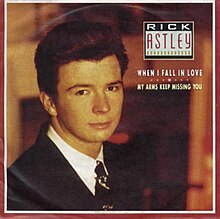
When I Fall In Love – Rick Astley
Although Mike, Matt and Pete had been operating as a trio since 1984, it wasn’t until 1987 that they made their first assault on the Christmas market, and, given that 1987 had been their most successful year yet, the ambitious producers set their sights on the Christmas number one.
1987 had seen SAW really start the move from trendy underground producers into mainstream pop hitmakers; big hits from Mel & Kim, Bananarama and Sinitta had made a huge impact, but arguably it was the success of Rick Astley which really proved that SAW had arrived.
Rick’s debut hit Never Gonna Give You Up was an instant classic and this reputation only continues to build with the passage of time, whilst the follow-up – a polished remake of O’Chi Brown’s Whenever You Need Somebody – further entrenched the 21-year-old from Newton-Le-Willows as a rising star.
So all eyes (and a few betting slips) were on Rick Astley when it was announced that he was releasing a cover version of When I Fall In Love as his third single in time for Christmas 1987.
The song itself, composed by Victor Young and Edward Heyman, was first recorded by Jeri Southern in 1952, and whilst many other singers have also recorded it, perhaps the best known and most loved recording is Nat King Cole’s. Whilst this version was recorded at Christmas 1956, it wasn’t issued until April 1957 and is not especially connected with Christmas.
The SAW-produced Rick Astley version was probably the first of the “faithful cover versions” that became a SAW staple; Mike, Matt and Pete would take an old song, give it to one of their artists and wrap it up in a modern take of the original arrangement. Yesterday’s Sound, Tomorrow’s Technology, if you like. Notable examples include Jason Donovan’s Sealed With A Kiss, Kylie Minogue’s Tears On My Pillow and Big Fun’s Hey There Lonely Girl, but Rick’s When I Fall In Love must be the pioneering example.
It’s a lush production, eschewing the then-emerging trademark SAW synth sound for a warm, string-led arrangement, which is actually credited to Gordon Jenkins (who was responsible for the string arrangement of the Nat King Cole Version). The synthesised strings are so effective (especially for 1987) that one could be forgiven for thinking they are real, and one senses the involvement of PWL’s Ian Curnow, who had joined the organisation that year and had been given the task of getting to grips with the Fairlight music computer. (Certainly, Curnow is credited on the Whenever You Need Somebody album sleeve as providing Fairlight programming on the SAW-produced tracks).
Rick performs the song effortlessly; clearly, his mellifluous voice suits the track, and has a similar tone to that of Nat King Cole, which probably inspired the song choice.
Whilst the song itself is not explicitly about Christmas, the warmth of the arrangement and production of Rick’s version (not to mention the opening’s similarities with the arrangement of Nat King Cole’s The Christmas Song) creates a real connection with the Yuletide season. However, it’s the video which reinforces the seasonal feel, with Rick walking through the snow outside a log cabin.
It would be churlish to criticise such a classic song as When I Fall In Love, and certainly SAW created a typically polished version, but equally it is fair to say this is not the most exciting of SAW tracks. (For this listener, the real excitement was on the flipside, which contained a new SAW composition and production My Arms Keep Missing You, and would itself become the A side in the New Year of 1988). One wonders about the real appeal to SAW’s core audience of these “faithful cover versions”, and When I Fall In Love is no exception. But perhaps that’s just me, as it did reach number 2 in the UK Singles Chart.
So, what stopped it from getting to number one? Well, it was another old song which claimed that top spot that Yuletide, but a rather more contemporary take than Rick’s. Pet Shop Boys took the crown with their hi-NRG version of Always On My Mind, an old standard previously recorded by Willie Nelson, Brenda Lee and, most famously, by Elvis Presley. Neil Tennant and Chris Lowe had, like Rick and SAW, enjoyed a successful 1987, and topped it off by turning a tender ballad into an explosive dancefloor extravaganza.
However, no matter how good the Pet Shop Boys track was, there is possibly a second reason why Rick failed to reach the top spot. At the same time as Rick’s version was climbing the charts, Nat King Cole’s version was re-released… by EMI Records. Which just happened to be the record company who owned Parlophone, the label who Pet Shop Boys were signed to. There are suggestions that this was a deliberate act to take away sales from Rick Astley, and therefore increase Pet Shop Boys’ chances on reaching number one. How true this alleged intention was is unknown, but as the Nat King Cole re-release hit number 4, there must have been some impact on Rick’s sales.
So, SAW’s first attempt at Christmas number one was ultimately unsuccessful, but number 2 ain’t such a bad result at all. As it was, SAW would make their second attempt at Christmas number one the following year, albeit an attempt which was effectively forced upon them…
Based upon and expanded from material originally published in 80s UK Christmas Singles (available on Kindle)


:format(jpeg):mode_rgb():quality(90)/discogs-images/R-1697045-1297146632.jpeg.jpg)

:format(jpeg):mode_rgb():quality(40)/discogs-images/R-1290258-1267623366.jpeg.jpg)



:format(jpeg):mode_rgb():quality(90)/discogs-images/R-671961-1154825189.jpeg.jpg)