In the run up to Christmas, what better way to get into the festive spirit than to take a look at 7 Yuletide tracks Stock Aitken Waterman came up with between 1987 and 2015? Join Kean Canter Mattowski for 7 blogposts during December as we take a look back at some seasonal gems…
On the fourth day of SAWmas, the DJ played for me…
When You Come Back To Me – Jason Donovan
1989 saw Mike, Matt and Pete dominate the charts with 7 number one singles, and a further 15 Top 40 hits. A significant part of this success was due to their collaboration with Jason Donovan, who followed Especially For You with two solo number ones (Too Many Broken Hearts, Sealed With A Kiss) and a number two hit (Every Day), and a number one debut album (Ten Good Reasons).
Jason and SAW would end such a successful year by making another attempt at a Christmas number one with the release of a new single - recorded in October 1989 - from his forthcoming second album.
When You Come Back To Me, written and produced by Stock Aitken Waterman, is an up-tempo number which manages to convey the Christmas spirit without making any explicit reference to the season.
Whilst it features the usual SAW hallmarks of synth brass and electronic percussion, it has a very seasonal feel to it; it's underpinned with timpani, swirling strings and prominent backing vocals, with chimes, tubular bells and timpani sprinkled on top. There's a nod to the time of year in the lyrics, with references to "so many people" with "smiles on their faces" and "armful of presents", and there being a "chill in the air". It's a tale of separated lovers, which of course resonates deeply in the Christmas season.
As with many SAW songs, the real strength lies in Mike Stock and Matt Aitken’s melody. The memorable chorus is euphoric, conflating Donovan’s hope of reunion with the hope that Christmas offers many, and Pete Hammond’s immaculate final 7” mix seals the deal that this is a bona fide hit record.
(The 2010 digital release of the When You Come Back To Me single bundle contains the Original 7” Mix, by Dave Ford; this mix dispenses with the distinctive brass found on the final 7” mix and is perhaps less energetic, but is actually more atmospheric and seasonal. It may lack the impact of the Hammond mix, but is an interesting take all the same).
In addition to the main single release, a second remix 7" was released featuring The Yuletide Sleigh List Mix -- this very much turned the track into a Christmas song; opening up with a spoken intro by Donovan, the track removes most of the frenetic percussion and synths which adorn the main version and replaces them by choral backing vocals, tinkly bells and plucked strings.
There were a number of various mixes of the track; the main Extended Version (mixed by Pete Hammond) is an atmospheric longer take on the 7” mix, with the elongated intro and outro showing off the various layers of the track. Dave Ford’s No Probs Mix takes the track into a dance direction, with Ford deploying an effective house approach, whilst the Guitar Instrumental Mix, also mixed by Ford, is a showcase for Matt Aitken as he plays the melody line on a classical guitar. The 2010 digital release contains a No Strings Mix, which was mixed by Ford and appears to be a slight variation on the Yuletide Sleigh List Mix, plus various instrumental and backing track versions.
When You Come Back To Me was fairly well received at the time, and is still fondly regarded by many even now. Perhaps just as memorable was the bright orange overcoat which Donovan wore in the video and on the single sleeve! The single sleeve, the design of which is actually credited to Donovan, also carries handwritten (and annotated) lyrics to the song, and given these appear to be written in two different sets of handwriting, it appears these were Stock and Aitken’s own original handwritten lyrics.
Given both Donovan and SAW's huge success in 1989, When You Come Back To Me would have likely been a Christmas number one -- had it not been for the rush-release of a particular charity single. However, that particular charity record did actually see both SAW and Donovan – and many others – reach number one on the 1989 Christmas charts…
In the run up to Christmas, what better way to get into the festive spirit than to take a look at 7 Yuletide tracks Stock Aitken Waterman came up with between 1987 and 2015? Join Kean Canter Mattowski for 8 blogposts during December as we take a look back at some seasonal gems…
On the third day of SAWmas, the DJ played to me…
The Christmas Medley – Stock Aitken Waterman
Back in 2010, SAW fans were delighted when PWL commenced a digital re-issue of much of its back catalogue, with a huge number of singles bundles containing various mixes, remixes, backing tracks and instrumentals. What added to the excitement was that these releases included previously unreleased material, and whilst a number of these were already known about and long anticipated, there were still some surprise items.
Including The Christmas Medley, credited to Stock Aitken Waterman.
Apparently, this track was specially recorded for the December 1989 Stock Aitken Waterman Go To The Albert Hall charity concert (which featured Jason Donovan, Sonia and Big Fun amongst others). The track was not performed at the event, but was played in the venue before and after the show. It would appear this was the track’s sole purpose and it was not designed or scheduled for general release.
The medley, which interpolates Rudolph The Red Nose Reindeer, White Christmas and Silent Night, was produced and arranged by SAW, with vocals provided by regular SAW backing vocalists Mae McKenna and Miriam Stockley, along with Mike Stock.
Opening with swirling harp, blustery wind and sleigh bells, Rudolph The Red Nosed Reindeer launches into a jaunty synth-backed retake on the famous song, with an occasional interruption by a weird synth squiggle which one assumes is supposed to be a cry of joy from the titular reindeer.
In a slightly jarring change of tone, White Christmas takes over around a minute into the track, with light percussion and strings backing the vocals, in which Stock can be clearly heard.
At the 2:30 minute mark, the track brings in Silent Night, in a much more complementary segue, with an arrangement akin to that of the previous song. Again, Stock can be clearly heard here too, and the combination of both male and female voices create a real warmth.
In the final 30 seconds, Stock sings a reprise of “Sleep in heavenly”, with McKenna and Stockley singing in counter.
It’s all good fun, and is very well done given its purpose. Whilst the White Christmas and Silent Night elements work really well together, the juxtaposition of those tracks with Rudolph The Red Nosed Reindeer is possibly less successful. That said, that track gives the track some jolliness, whereas the other two tracks are perhaps more contemplative, and perhaps I am being a bit too Scrooge-like to scrutinise a fun Christmas track designed as background music.
It’s a worthy addition to a Christmas playlist, as it’s very evocative and festive. The digital release also includes an instrumental version.
This was not the only Christmas SAW action back in 1989, however. In fact, they had two singles vying for Christmas 1989, one of which was (and is) Christmassy without actually being about Christmas…
In the run up to Christmas, what better way to get into the festive spirit than to take a look at 7 Yuletide tracks Stock Aitken Waterman came up with between 1987 and 2015? Join Kean Canter Mattowski for 8 blogposts during December as we take a look back at some seasonal gems…
On the second day of SAWmas, the DJ played to me…
Especially For You – Kylie Minogue and Jason Donovan
If Mike Stock, Pete Waterman and others around the SAW operation at the time are to be believed, then the trio’s second attempt at a Christmas number one was unplanned and mounted at the last minute.
1988 had seen the huge success of Neighbours actress Kylie Minogue’s debut album and its string of hit singles, making her a superstar and turning Stock Aitken Waterman into household names. Her fellow Neighbours actor Jason Donovan had also teamed up with SAW towards the end of the year, and had enjoyed a hit with his debut single Nothing Can Divide Us.
As Kylie and Jason’s Neighbours characters were boyfriend and girlfriend, there was much speculation as to whether the pair were an item in real life. Whilst it later turned out they were in-fact dating, this speculation was denied at the time, but did not dampen the public’s romantic hopes of them being in love.
With both parties having launched pop careers, the speculation switched to whether or not Kylie and Jason would release a duet for Christmas. Waterman, in his autobiography I Wish I Was Me, remembers that he was constantly approached by teenagers asking when the Kylie and Jason song would be coming out.
Stock, in his memoir The Hit Factory: The Stock Aitken Waterman Story, adds that there were growing calls for a Kylie and Jason duet, and that SAW initially resisted these, but changed their minds when Woolworths apparently tried to place an advance order for 400,000 copies of the mythical duet!
PWL’s marketing manager Tilly Rutherford came up with the title, and as the main songwriter of the trio, Stock set to work on the composition. The only problem was that both Kylie and Jason had returned to Australia, so SAW recorded a demo version of the track (a short clip can be found below), with Mae McKenna performing the Kylie parts and Stock singing the Jason parts.
It fell to Aitken and Waterman to fly out to Sydney to record Kylie and Jason’s vocals, with the full track being completed upon their return.
Given how successful the track was, it seems surprising to discover that there were some misgivings about the track once the initial mixes came in. Waterman states that he hated the initial version, suggesting that it lacked passion, and added that Stock also disliked it.
In an interview with Paul Smith, Waterman states that the problem with the initial version was that SAW had “tried to make it Peaches and Herb but it didn’t work”. (Note: Peaches and Herb were a 70s soul duo, who recorded Reunited, a ballad about a couple getting back together, as is the case with Especially for You).
Waterman goes on to say that Stock carried out a further remix, but “it still wasn’t wonderful, so I thought I’d have a go. Somehow it all came together at the last moment…”
This is a great story delivered with typical Waterman bonhomie, but a glance at the record sleeve will tell you that it was in fact Pete Hammond who was responsible for the final mix.
In his memoir Get Down Here Quick And Mix Yourself A Hit!, Hammond states that several mixes had been done by various engineers, but PW rejected them all on the basis that the track “just didn’t feel right” and eventually got Hammond to do it.
Hammond comments that he called up the master to prepare his mix, and was of the opinion that there was a drum timing problem. He fixed this and changed the kick sound, but apparently the main change he made was to the intro. The original mix opened with a two-part drum hit, followed by Kylie’s first line. Hammond took some backing harmonies from the bridge (performed by Mae McKenna, Miriam Stockley and Mike Stock), and put them right at the start of the song, creating that evocative opening.
One of those early mixes has been released (see below); this particular mix fades in with a drawn out synth pad before the two-part drum hit, and straightaway it’s clear that Hammond’s clever cut and paste creates an impact the early mix perhaps lacks. In addition, the drum track lacks the punch of the final mix, whilst the synth pads of the early mix are swapped for some nice guitar work in the final version.
All that said, it is clear that the final version has other instrumentation the earlier version lacked, so it appears that Stock and Aitken did some overdub work prior to Hammond’s final mix, which may be the 4 hour mixing session Waterman refers to.
If I’m totally honest, I wasn’t crazy about the record at the time (I think I felt it a bit slushy when in fact many SAW ballads have a bit of an edge to them) but listening to that final version now, there is much to appreciate about both song and the record. The backing vocals bring real warmth, as do the strings and the Spanish guitar solo, creating a lighter-than-usual backing for the main vocals. Kylie probably sounds the most comfortable here; whilst Jason’s voice would improve considerably with each release, he was still new to recording at this time. That said, his voice is pleasant here and does not detract from proceedings. Lyrically, it’s great to have a SAW song about two former lovers reuniting (rather than splitting up, or worse, not getting together at all!), whilst the fluid melody of the verses sells the tentative nature of these two lovers getting back together. The chorus is joyous and memorable, and both vocalists sound great here.
The B-side carried another Kylie and Jason duet, All I Wanna Do Is Make You Mine, which is a fun, upbeat number with Grease leanings. I probably preferred this at the time, with its clattering drums, rumbling bass, chugging guitars and horn blasts really selling the catchy melody, most notably its wonderful bridge.
As it was, Especially For You was issued in time for Christmas, but, just like the 1987 battle for Christmas number one, SAW were thwarted by EMI Records, as Cliff Richard’s Mistletoe and Wine claimed the Yuletide number one. Whilst widely derided, it is clear that Cliff’s tribute to a traditional British Christmas appealed to a large section of the record buying public. It wasn’t all bad news for Kylie, Jason and SAW, as Especially For You was the first number one single of 1989, selling just short of a million copies.
And as 1989 would prove to be SAW’s most commercially successful year, they would go on to have two records vying for the Christmas number one that year. However, it turns out that there would be a third Christmas track from SAW that would go unreleased for over 20 years…
In the run up to Christmas, what better way to get into the festive spirit than to take a look at 7 Yuletide tracks Stock Aitken Waterman came up with between 1987 and 2015? Join Kean Canter Mattowski for 8 blogposts during December as we take a look back at some seasonal gems…
On the first day of SAWmas, the DJ played for me…
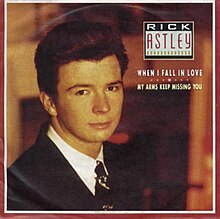
When I Fall In Love – Rick Astley
Although Mike, Matt and Pete had been operating as a trio since 1984, it wasn’t until 1987 that they made their first assault on the Christmas market, and, given that 1987 had been their most successful year yet, the ambitious producers set their sights on the Christmas number one.
1987 had seen SAW really start the move from trendy underground producers into mainstream pop hitmakers; big hits from Mel & Kim, Bananarama and Sinitta had made a huge impact, but arguably it was the success of Rick Astley which really proved that SAW had arrived.
Rick’s debut hit Never Gonna Give You Up was an instant classic and this reputation only continues to build with the passage of time, whilst the follow-up – a polished remake of O’Chi Brown’s Whenever You Need Somebody – further entrenched the 21-year-old from Newton-Le-Willows as a rising star.
So all eyes (and a few betting slips) were on Rick Astley when it was announced that he was releasing a cover version of When I Fall In Love as his third single in time for Christmas 1987.
The song itself, composed by Victor Young and Edward Heyman, was first recorded by Jeri Southern in 1952, and whilst many other singers have also recorded it, perhaps the best known and most loved recording is Nat King Cole’s. Whilst this version was recorded at Christmas 1956, it wasn’t issued until April 1957 and is not especially connected with Christmas.
The SAW-produced Rick Astley version was probably the first of the “faithful cover versions” that became a SAW staple; Mike, Matt and Pete would take an old song, give it to one of their artists and wrap it up in a modern take of the original arrangement. Yesterday’s Sound, Tomorrow’s Technology, if you like. Notable examples include Jason Donovan’s Sealed With A Kiss, Kylie Minogue’s Tears On My Pillow and Big Fun’s Hey There Lonely Girl, but Rick’s When I Fall In Love must be the pioneering example.
It’s a lush production, eschewing the then-emerging trademark SAW synth sound for a warm, string-led arrangement, which is actually credited to Gordon Jenkins (who was responsible for the string arrangement of the Nat King Cole Version). The synthesised strings are so effective (especially for 1987) that one could be forgiven for thinking they are real, and one senses the involvement of PWL’s Ian Curnow, who had joined the organisation that year and had been given the task of getting to grips with the Fairlight music computer. (Certainly, Curnow is credited on the Whenever You Need Somebody album sleeve as providing Fairlight programming on the SAW-produced tracks).
Rick performs the song effortlessly; clearly, his mellifluous voice suits the track, and has a similar tone to that of Nat King Cole, which probably inspired the song choice.
Whilst the song itself is not explicitly about Christmas, the warmth of the arrangement and production of Rick’s version (not to mention the opening’s similarities with the arrangement of Nat King Cole’s The Christmas Song) creates a real connection with the Yuletide season. However, it’s the video which reinforces the seasonal feel, with Rick walking through the snow outside a log cabin.
It would be churlish to criticise such a classic song as When I Fall In Love, and certainly SAW created a typically polished version, but equally it is fair to say this is not the most exciting of SAW tracks. (For this listener, the real excitement was on the flipside, which contained a new SAW composition and production My Arms Keep Missing You, and would itself become the A side in the New Year of 1988). One wonders about the real appeal to SAW’s core audience of these “faithful cover versions”, and When I Fall In Love is no exception. But perhaps that’s just me, as it did reach number 2 in the UK Singles Chart.
So, what stopped it from getting to number one? Well, it was another old song which claimed that top spot that Yuletide, but a rather more contemporary take than Rick’s. Pet Shop Boys took the crown with their hi-NRG version of Always On My Mind, an old standard previously recorded by Willie Nelson, Brenda Lee and, most famously, by Elvis Presley. Neil Tennant and Chris Lowe had, like Rick and SAW, enjoyed a successful 1987, and topped it off by turning a tender ballad into an explosive dancefloor extravaganza.
However, no matter how good the Pet Shop Boys track was, there is possibly a second reason why Rick failed to reach the top spot. At the same time as Rick’s version was climbing the charts, Nat King Cole’s version was re-released… by EMI Records. Which just happened to be the record company who owned Parlophone, the label who Pet Shop Boys were signed to. There are suggestions that this was a deliberate act to take away sales from Rick Astley, and therefore increase Pet Shop Boys’ chances on reaching number one. How true this alleged intention was is unknown, but as the Nat King Cole re-release hit number 4, there must have been some impact on Rick’s sales.
So, SAW’s first attempt at Christmas number one was ultimately unsuccessful, but number 2 ain’t such a bad result at all. As it was, SAW would make their second attempt at Christmas number one the following year, albeit an attempt which was effectively forced upon them…
Based upon and expanded from material originally published in 80s UK Christmas Singles (available on Kindle)
As is very clear from the header and strapline above, this is a blog which explores the work of Mike Stock, Matt Aitken and Pete Waterman. So bear with me as I take a slight diversion to talk about 80's pop group Bucks Fizz.
Under the auspices of songwriter/producer Andy Hill, Buck's Fizz's original 1980s run of material (running from 1981's Making Your Mind Up through to 1988's Heart of Stone) is a strong, and often underrated, back catalogue, with its reputation perhaps undermined by the band's initial Eurovision status. Making Your Mind Up is a fun, frothy party track, but its late 70s pub band sound is unrepresentative of what was to come later. However, Hill's adoption of new technology for second album Are You Ready? album saw him give the Buck's Fizz sound a much needed boldness and modernity. The result were two number hits with The Land of Make-Believe and My Camera Never Lies, both tracks displaying Hill's love of complex vocal harmonies and tricksy drum programming. Third album Hand Cut was again led by Hill, albeit with songwriting and production contributions from others, resulting in hits with If You Can't Stand the Heat and When We Were Young. A terrible coach crash had a devastating impact on the band, not only personally (the band suffered serious injuries, most notably Mike Nolan) but also professionally, with 1984's I Hear Talk album not achieving the success it deserved. The band took time out to recover from the accident, but also had to deal with the departure of Jay Aston. The band (with new member Shelley Preston) would return to the charts with 1986's New Beginning (Mamba Seyra), but worthy follow-ups failed to make any huge chart impact. Ironically, the band's final single of the 1980s - Heart of Stone - would later be a huge hit for Cher, but missed the Top 40 in its original incarnation.
The intervening years have been a fascinating if frustrating time for the original members of Buck's Fizz; the band saw members drop out of the line-up, then saw a spin-off led by Mike Nolan and Dollar's David Van Day, followed by further re-groupings. There now exists two "splinter" versions of the band; Bucks Fizz, led by original member Bobby G with three non-original performers, and The Fizz (aka Formerly of Bucks Fizz), which comprises original members Cheryl Baker, Mike Nolan and Jay Aston, plus Bobby McVay (who was part of the line up for the 1983 UK Eurovision act Sweet Dreams).
Which brings us right up to date -- and the reason I am writing about all this on a SAW blog.
The Fizz have teamed up with Mike Stock, and have been working on new material over the past year or so. (Indeed, fans had a sneak preview of this new material with the limited release of a Christmas-themed The Land Of Make Believe 2016).
It's an interesting collaboration, but one that probably makes sense for both parties at this point in time. It's not entirely without precedent, as Pete Waterman states in his autobiography that RCA A&R man Peter Robinson approached him in 1985 to see if SAW could come up with some new material for Bucks Fizz -- although it appears nothing came of this request. It's also worth noting that it is believed that Stock and Hill knew each other; indeed, Stock and Aitken recorded their first post-SAW release -- No More Tears (Enough Is Enough) by Kym Mazelle and Jocelyn Brown -- at Hill's Comfort Place studio.
Whilst there was no tangible collaboration between SAW and Bucks Fizz in the 1980s, it does sound like Mike Stock had some kind of long-held desire to work with the band; in a 2016 interview with Xanthe Bearman, he referred obliquely to The Fizz project, citing that he was working with them "for reasons that I have deep within my soul"!
Now, thanks to a very successful Pledgemusic campaign, The Fizz are due to release a brand-new album, The f-z of Pop, in September 2017. Produced by Mike Stock and Jimmy Junior, the album comprises 8 new songs, 3 remade BF songs plus additional mixes. And today (Tuesday 1 August 2017) saw the first airplay of the album's lead track, Dancing In The Rain.
It's a great, catchy track; it has the trademarks of classic Buck's Fizz but one can hear elements of Steps in there too. Some nice percussive elements, guitar work and incidental synth sounds, but it has a nice laidback feel which would see it sit well on the Radio 2 playlist (here's hoping!).
Overall, it's a solid return to form, and any new pure pop track is very welcome these days. I'm certain the dedicated The Fizz fanbase will be pleased, but whether the SAW purists will be as pleased remains to be seen. I for one look forward to the album and hearing the full results of this interesting collaboration.
So -- after an unplanned hiatus! -- here is the second part of my list of the 10 SAW B-sides which I would have made the A-side!
In case you missed part one, the criteria for the list is:
• Written (and/or co-written) by SAW
• Standalone tracks not belonging to an original artist album
• A full song with lyrics
So, without further ado, here's my Top 5!
5) Closer – Kylie Minogue
[B-side to Finer Feelings]
As Kylie Minogue approached the end of her tenure with PWL Records, she clearly had a growing influence on her material. Certainly, the whole Let’s Get To It album demonstrated this, even if the singles chosen to promote the album did not necessarily reflect this change in style. This new direction was probably more keenly felt in the B-sides of those singles; Say The Word – I’ll Be There (previously covered in part one of this article), the house-techno pastiche I Guess I Like It Like That, the storming Do You Dare?, and this track, the B-side to adult ballad Finer Feelings. Kicking off with a hypnotic metallic synth and heavy breathing, Closer sets out its stall from the outset – a spooky and sensual deep house track that takes Kylie and Stock & Waterman into new territory. The robust house beat and the vocal locs show a more mature, less tricksy approach to Stock’s arrangement than previously demonstrated, with an amazing squelching synth workout in the middle. Minogue’s vocals appear to have a filter applied in places, which adds to the trippy sense to proceedings. But Stock (with Waterman and Minogue on co-writing duties) also takes an alternative approach with the song’s construction; it only has two verses (as opposed to the usual three), with the chorus tacked on to the end of each – with quite a gap between both of those verses. There is also no bridge as such (a key part of many SAW tracks). The lyrics have a pleasingly elliptical style to them, hinting towards the pleasure of sexual union (which actually complements the lyrics of the A-side), and these are of course reinforced by the heavy breathing which punctuates the track. Overall, it’s a refreshingly adult track in term of theme and sound; whilst there would be a year and two further PWL single releases before Minogue released the post-PWL Confide In Me, Closer actually indicates the mature stylised direction Minogue would take with her initial DeConstruction material. As much as I love and admire Finer Feelings, Closer was actually an utterly contemporary track that would have set a new course for both Minogue and Stock & Waterman – and arguably, the producers would have benefited more from such a re-evaluation at that time.
4) Never Knew Love Like This Before – Nancy Davis
[B-side to Higher And Higher]
Pizza-waitress turned karaoke-contest-winner turned pop-star Nancy Davis was a real missed opportunity for Stock & Waterman and PWL; her strong soulful voice and striking looks made her a real candidate for a new star for the 90s, and her debut track If You Belonged To Me was a strong classy house/pop crossover. However, when this track missed the top 40, her follow-up (and sadly, final release) took safer ground with a cover of Jackie Wilson’s Higher and Higher; whilst a joyful take on that classic, it took Davis away from the credible house/soul path and towards pure pop. The B-side was more interesting; again, more pop than house, but Never Knew Love Like This Before at least went some way into creating a new style that could be Davis’ own. The arrangement is a strange brew of both the 80s and 90s S(A)W sound; the house piano and brass base the track in 1992, whilst the vocal locs and incidental chime sounds hark back to the producer’s golden period. The elasticity of Stock’s melody allows Davis’ voice to shine, with her tackling the almost conversational lyrics, which present Davis telling the world how happy her new relationship has made her. One striking element of this track is that Mike Stock is on solo backing vocals here, and you can hear his isolated vocals just after the instrumental break. As with Say The Word – I’ll Be There, Stock cites this as another favourite B side, classing it as a bit of an experiment. And I guess that’s a good description. It sounds like Stock trying to forge a new pop sound for the 90s; if anything, he was a bit early – whilst this sound would have played better later in the decade, it didn’t really fit with the chart fare of 1992. As such, I’m not sure Never Knew Love Like This Before would have been a hit at that time, but, as per the challenge I set myself with this article, I’d have chosen this as the A-side over Higher And Higher.
3) Made In Heaven – Kylie Minogue
[B-side to Je Ne Sais Pas Pourquoi]
You might say this is a slight cheat, as Made In Heaven was originally intended as a double A-side single with Je Ne Sais Pas Pourquoi. This French-styled classic track was the fourth single from the massive Kylie album, so there many have been concerns over its chart performance given that so many people already owned it on the album and that is why new track Made In Heaven was appended to the release. As it was, Je Ne Sais Pas Pourquoi was another smash hit, peaking at #2 in the UK Singles Chart – and as a result, the single was never “flipped” to make Made In Heaven the A-side. A great pity, cos this one’s a little gem that deserves to be better known. Heavy on plucked strings and luscious synth pads, this tale of a girl building up to a first kiss is brought alive by an irresistible melody. The verses and bridge are exquisite enough, but that chorus just knocks it out of the park. It just shows the confidence and the winning streak of SAW at that point that such a belter of a pop track could be consigned to the flipside of another bona fide hit. Most SAW fans will know this one, but well worth checking out if you don’t.
2) You Changed My Life – Mel & Kim
[B-side of That’s The Way It Is]
Back in 1988, there was a lot of anticipation regarding a second Mel & Kim album. Whilst there was talk of recording taking place with other producers (notably Prince alumni David Z), further recording with SAW was anticipated. Alas, Mel Appleby tragically lost her fight against cancer and the full potential of Mel & Kim was never realised. The only tantalising glimpses of that second album were the hit single, the bold, classy That’s The Way It Is, and its B-side, You Changed My Life. A co-write between SAW and the Appleby sisters, You Changed My Life is a full-on pop frenzy, yet still possessing the cool dance edge of previous material. The chorus is solid gold A-side material, whilst the verses are perhaps even better, with an intoxicating melody, moody synths and winning vocals. Lots of lovely incidental synth sounds make this a proposition that’s hard to turn down. It appears there are two mixes of this track; the sparse, funky version that was actually the B-side, and a warmer, poppier version that features on the 2010 Cherry Red Deluxe Edition of the FLM album.
And in pole position is…
1) She’s In Love With You – Jason Donovan
[B-side to Happy Together]
In many ways, this track was the last hurrah for Donovan’s work with the original SAW team; it featured on the B-side of the Stock & Waterman-produced Happy Together, which was Donovan’s final single release on PWL Records. As good as the A-side was (a lovingly created take on The Turtles classic), few knew of the absolute belter that lay hidden on its B-side. You could almost class She’s In Love With You as the definitive Jason SAW track; it kicks off with a cracking electric guitar riff (a la Too Many Broken Hearts); it features soaring strings which evoke the emotion of Jason’s tale of thwarted love (“No matter what I planned / She never let me hold her hand”), and it has The Chorus To End All Choruses. Seriously, this chorus is WASTED on a B-side but then it’s so amazing that had the track been an A-side, it would have punched a hole through the universe. I can’t really find the words to describe how catchy the chorus is, but of particular note are the three last lines – “There’s nothing more to say / I’m gonna walk away / And live to love another day” – which are delivered in a breathless rhyming triplet and is yet further proof if any were needed) of Mike and Matt’s songwriting skills. It is a crime that this track was not an A-side; okay, I get that it was a nod back to Jason’s 1989 sound and may not have been deemed as truly contemporary in 1991, but this is a solid gold 24 carat pop smash that never got the chance to prove it.
+++++
Again, I stress this is my personal list and that, crucially, it is not necessarily a list of the best or my favourite B-sides -- this is a list of B-sides that I would have swapped with the A-side track for single release.
I'll be exploring the other SAW B-sides in a future article, as there are some fascinating tracks included in that canon.
As a Stock Aitken Waterman fan in the 1980s and early 1990s, one would become resigned to the fact that the B-side of many single releases would be an instrumental version of the A-side. As my love of all things SAW has deepened over the years, I’m now delighted to have so many instrumental versions that allow me to listen closely and pick out the different elements which make up the song.
As a teenager desperate for original SAW material, I was a bit frustrated by this reliance upon the instrumentals – but I guess this made the appearance of a brand new original SAW track on the B-side a VERY EXCITING EVENT!
Sure, some tracks would impress more than others, but every so often you’d get a SAW B-side which was just as good as the A-side, and in some cases, even better than the A-side.
So here is my – admittedly personal – list of the 10 SAW B-sides which I would have made the A-side!
The criteria for the list is:
Written (and/or co-written) by SAW
Standalone tracks not belonging to an original artist album
A full song with lyrics
The latter point means that tracks such as I Wanna Be Your Everything by Delage, Just Call Me Up by Jason Donovan, and Do You Dare? by Kylie Minogue are excluded. As are the instrumental pieces SAW created for the Pat & Mick B-sides (although a separate article on these will follow).
Likewise, instrumental and dub mixes of the A-side are also excluded.
Hopefully, you will find some of your favourites in this list, but I’m equally as certain that you may be aggrieved that I have missed some obvious choices out. Yes, I’ve left out certain Kylie and Jason tracks which I love, but I don’t want this to be a list full of their tracks.
So here goes, in reverse order!
10)I Wanna Shout About It – Delage
[B-side to Running Back For More]
This infectious slab of dance pop from early 1990s SAW girl band Delage appears to have had an interesting genesis. As lovely as the A-side Running Back For More is, this meaty, utterly contemporary banger is probably the more commercial cut of the two tracks, and it is a mystery why this was consigned to B-side status. That said, the recent re-issue of Running Back For More carries additional mixes of I Wanna Shout About It, including 7” and 12” mixes, which suggests that it was considered as an A-side. So we have two key versions: a full vocal single version, and the version that made the B-side of Running Back For More, which omits the verses. The full vocal version is just glorious, with a strong lead vocal and some great backing harmonies, but the official B-side version heads more in the direction of the limited vocal style of contemporaneous dance tracks. A big dirty synth riff and some frantic house piano kicks off proceedings, whilst the solid beat and shifting synth pads give this track a real edge which takes it away from the standard SAW sound of the time towards the tough dance sounds dominating the charts at the time. A great marriage of pop sensibilities and house influences, this was a real missed opportunity for both the band and producers. One of the emerging themes from this top 10 list of B-sides is how S(A)W were able to demonstrate they were still more than capable of remaining current and up-to-date in the early 1990s, but maybe there was a lack of confidence somewhere in terms of being more adventurous in choices of single material.
9) Say The Word – I’ll Be There - Kylie Minogue
[B-Side to Word Is Out]
Whilst Word Is Out still appears to be a polarising song for S(A)W and Kylie fans, its B-side Say The Word – I’ll Be There garners a much warmer reception. Composed by Stock, Waterman and Minogue, this smooth, mature mid-tempo ballad is worlds away from the beat-led and brass-boasting affair on the A-side. Underpinned by rich, rolling piano and made all the sweeter by the glorious backing vocals, Say The Word sees Kylie in pining mode as she makes her case to the object of her affections. It’s a further development of the Kylie sound; however, where the listener can hear the S(A)W DNA deep within Word Is Out, one could be forgiven for thinking that Say The Word had been produced by a different production team. It’s lush, with a real organic feel to its arrangement and production, with little in the way of electronic sounding synths and percussion to betray the trademark sound of its producers. Certainly Mike Stock, in his recent interview with Nick Moon, cited this track as one of his favourite B-sides. Whilst it perhaps wouldn’t have been the best choice for the first single of Kylie’s fourth album campaign, it would have made for a good third or fourth single and perhaps indicated a new direction for S&W and Kylie had they continued to work together. I would add though that it is almost a crime that the track didn’t make the Let’s Get To It album.
8) Story of My Life - Jason Donovan
[B-side of Rhythm of the Rain]
B-sides often allowed SAW to try something a little different, and during their imperial pure pop phase of 1988-1990, such experimentation was very welcome. So it was that the B-side of Jason’s Rhythm of the Rain gave us Baggy Jason (baggy, of course, being the early 1990s term to describe what would later be called indie). Story of My Life is a standard Jason tale of bad luck in love (“And by the way, if you’re looking for sunshine, I ain’t the luckiest one / If you come with me, there’d be cloud in the desert / or a total eclipse of the sun”), but the arrangement and production presents a real change to the SAW sonic palette of the time. Kicking off with wailing guitars, Jason’s tale of woe is backed by a solid electric guitar riff, honky-tonk piano and a thumping beat, whilst the inclusion of brass and organ enlivens proceedings further. As Tom Parker points out in his excellent sleeve notes for the Between the Lines Deluxe reissue, this track finally gives Jason the Happy Mondays-style track he’d coveted for some time, and surely he must have been pleased with the outcome. That’s why I think it’s a crying shame this languished on a B-side; it’s a million times more adventurous than the pleasant cover version that made the A-side. This track would have really benefited Donovan’s profile – it’s poppy enough to keep the SAW and Jason fanbase, but also different enough to pull in a wider audience – and would have been a good direction for both parties to head for.
7) Another Lover – Bananarama
[B-side of Last Thing On My Mind]
Please Yourself, Bananarama’s 1993 album with Stock & Waterman, received mixed reactions upon its original release, and actually remains a polarising collection amongst S(A)W and Bananarama fans to this day. I can’t help but wonder if that reception would have been improved at all by the inclusion of this track, which was on the flipside of Last Thing On My Mind but omitted from the album. It’s a decision which beggars belief, as this is a superior slab of 70’s disco-styled pop. The use of real strings (no doubt recorded in the same sessions as those for Give It All Up For Love and Is She Good To You?) creates an authenticity of the sound, whilst the addition of brass, funky rhythm guitar and rattling drums just adds to the joyous feel – even if lyrically it’s a tale of Keren and Sara telling a straying lover to pack their bags and go. Happily, the track eventually made it to the album on subsequent reissues, thus righting the original wrong, but for my money, this should have been an A-side back in 1992/1993.
6) Better Than Ever - Sonia
[B-side to Listen To Your Heart]
This sparky uptempo track had a former life, planned as it was to be a fourth Stock Aitken Waterman-branded single in 1989, featuring sometime PWL singer Lisa Fabien as guest vocalist. That version was never released at that time (although was finally issued as part of the PWL iTunes releases many years later), but you can’t keep a good SAW tune down, so it was eventually recorded by Sonia – but insanely was consigned to B-side status. It only takes one listen to know this is a hit record not given the chance to be one. Driven by a solid beat and a mean bass, the track is a perfect concoction of synth fx, brass riffs and guitar licks, providing a thrilling backdrop to Sonia’s tale of her sickeningly perfect relationship. As much as I love the A-side – a moody, house-influenced affair and much underrated – I do think Better Than Ever was a missed opportunity for another hit for Sonia.



:format(jpeg):mode_rgb():quality(90)/discogs-images/R-671961-1154825189.jpeg.jpg)